

LEGO Star Wars UCS sets can look like simply larger, more expensive versions of ordinary LEGO Star Wars sets, but that is not quite what the label means. The biggest difference is purpose. LEGO describes the Ultimate Collector Series as detailed, challenging models designed primarily for display and adult collectors, while the wider LEGO Star Wars range includes everything from play-focused sets to smaller display models, dioramas, helmets, droids, and starships.
That means “UCS” is not just shorthand for “big LEGO set.” A set can be large, expensive, detailed, or marked 18+ without being part of the Ultimate Collector Series. UCS is a specific LEGO Star Wars product line with its own history, design priorities, and collector identity.
If you are still learning the label itself, start with our guide to what UCS means in LEGO Star Wars. This guide focuses on what actually changes when you compare UCS with the broader LEGO Star Wars lineup.
What Is the Main Difference Between UCS and Regular LEGO Star Wars Sets?
The simplest answer is that UCS is a collector-focused display series, while “regular LEGO Star Wars sets” is not one official category. It is a convenient way to describe the rest of the LEGO Star Wars range, which contains many different kinds of products.
LEGO says Ultimate Collector Series models are detailed, unique, challenging, and meant for display. The company also describes the current UCS range as impressively large collectible sets made specifically with adult collectors in mind. That gives UCS a much narrower purpose than the overall Star Wars theme.
Outside UCS, LEGO Star Wars includes traditional playsets, smaller starships, battle packs, dioramas, helmets, brick-built characters, adult display models, and newer interactive products. Some of those sets are designed mainly for play. Others are clearly meant for display. The absence of a UCS label does not automatically tell you which one you are looking at.
Are UCS Sets Always Bigger?
UCS sets are often larger than standard versions of the same kind of ship, but size alone does not define the series. Current UCS models include everything from relatively compact starfighters and walkers to enormous capital ships and display environments.
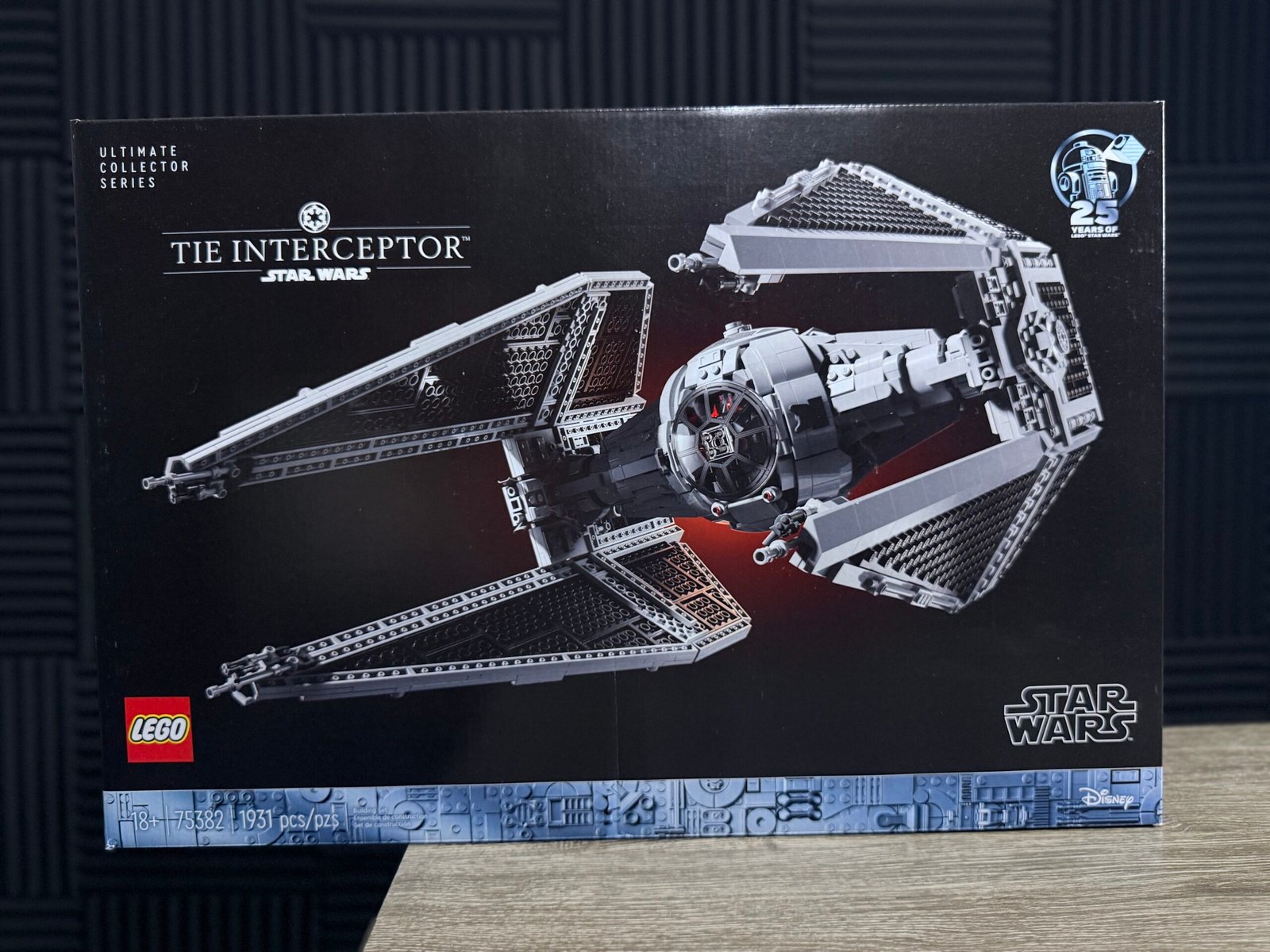
LEGO’s current UCS lineup shows how wide that range can be. The TIE Interceptor 75382 has 1,931 pieces, while the Executor Super Star Destroyer 75457 has 6,130 pieces and stretches more than 53.5 inches long. The Death Star 75419 goes even higher by piece count at 9,023 pieces.
Those examples also show why piece count is not the same thing as physical size. A long ship, a tall walker, and a dense location build use space differently. If display footprint matters more than the UCS label itself, our Executor 75457 display-space guide shows how quickly real-world dimensions become the important number.
Are UCS Sets More Detailed Than Regular Sets?
That is one of the clearest differences. UCS models usually have more room to reproduce proportions, surface detail, mechanical texture, and shaping that would be difficult at a smaller scale. LEGO’s own history of the series repeatedly highlights improved accuracy, advanced building techniques, and more detailed recreations of familiar Star Wars vehicles.
More detail does not always mean more moving features. A smaller play-oriented set may include spring-loaded shooters, opening compartments, easy-access cockpits, or other functions designed for active play. A UCS set may instead use that space and piece count to refine the shape, structure, or appearance of the model.
The emphasis is different. UCS tends to ask, “How accurately and impressively can we represent this subject as a collectible display model?” A play-focused set may ask, “How can someone recreate scenes and interact with this vehicle or location?”
Do UCS Sets Have More Play Features?
Not necessarily. LEGO explicitly distinguishes display-focused UCS models from its Master Builder Series, which uses complex builds but places more emphasis on play features, functions, interiors, and scene recreation.
That does not mean a UCS set cannot have an interior, moving parts, minifigures, or interactive sections. Some do. The point is that those features are not what makes a set UCS. Display quality, detail, scale, and collector presentation are more central to the series identity.
The wider LEGO Star Wars lineup often gives younger builders and play-focused fans easier access to recognizable ships and characters at smaller sizes. That can make a regular set more useful for actual play even when the UCS version is more impressive as a display piece.
Are UCS Sets Harder to Build?
Usually they involve a larger commitment, but “harder” is not a single measurement. UCS builds may include more pieces, larger subassemblies, unusual angles, Technic structures, repeated surface detailing, and longer instruction sequences. That can make them more demanding in time, space, and concentration.
LEGO itself describes UCS as a challenging series, but the instructions still guide the model step by step. A patient builder who is comfortable following LEGO instructions does not need to be an engineering expert before starting one. For a deeper breakdown, our guide to how hard LEGO UCS sets are to build covers beginner mistakes, organization, build sessions, physical size, and readiness.
The practical challenge can matter as much as the techniques. Large sections need somewhere to sit, long builds may span several sessions, and the completed model may be awkward to lift or move. Our first UCS set guide covers those planning questions before you commit to a model.
Does 18+ Mean a LEGO Star Wars Set Is UCS?
No. An 18+ age mark does not make a set part of the Ultimate Collector Series. LEGO sells many adult-focused Star Wars models that are not UCS, including helmets, dioramas, brick-built characters, and other display pieces.
The UCS label has to be attached to the product itself. The age marking tells you about the intended audience and presentation, while UCS identifies a specific collector series within LEGO Star Wars.
This is one of the easiest places for new collectors to get confused because both categories often share black adult-oriented packaging, display emphasis, and higher levels of detail. The overlap is real, but the labels are not interchangeable.
Do UCS Sets Always Include a Display Plaque?
LEGO’s help guidance describes a collector display card as part of UCS presentation. Modern vehicle-focused UCS sets commonly use an information plaque or display element alongside the finished model, reinforcing the idea that the set is intended to be presented as a collectible object.
That kind of presentation helps distinguish UCS from a typical playset, where the finished model may be designed to be picked up, repositioned, opened, and played with rather than placed beside a collector information card.
Presentation details can evolve over time, so the safest way to judge a specific set is still to check LEGO’s official product description rather than assuming every historical UCS release follows the exact same packaging or plaque format.
Are UCS Sets More Expensive?
UCS models are often among the more expensive LEGO Star Wars releases because they tend to use more pieces, larger structures, premium display formats, and longer development-intensive builds. But price is not a formal definition of UCS.
The current UCS lineup spans a wide price range rather than one fixed tier. A smaller UCS starfighter or walker can cost far less than a flagship capital ship or the largest location model. At the same time, non-UCS adult display sets can also be expensive.
So if you are deciding between UCS and a regular set, compare what you actually want from the model instead of assuming the higher price automatically means a better choice.
Which Is Better for Display?
UCS is specifically built around display, so it is usually the stronger choice when the goal is a centerpiece model with scale, detail, and collector presentation. That does not mean non-UCS sets look poor on a shelf. LEGO now produces many excellent display-oriented Star Wars sets outside UCS.
The bigger issue is space. A UCS model can dominate a shelf, desk, or cabinet in a way a smaller set does not. The display itself becomes part of the ownership experience because you may need deeper furniture, a stand, an enclosure, or a dedicated surface.
If you are trying to work out what will physically fit in your room, use our guide to displaying a huge LEGO Star Wars set. The best display model is still a problem if it has nowhere safe to live.
Which Is Better for Play?
For frequent hands-on play, a smaller regular LEGO Star Wars set is often the more practical choice. It may be lighter, easier to hold, simpler to repair, and designed with features that encourage scene recreation.
UCS sets can certainly be handled and enjoyed beyond the shelf, but very large models may be awkward to pick up and can contain detailed sections that are easier to knock loose. That is especially true once a model becomes wide, long, heavy, or structurally complex.
Neither approach is automatically better. They serve different ways of enjoying LEGO Star Wars.
UCS vs. Regular LEGO Star Wars Sets at a Glance
- Series identity: UCS is a specific LEGO Star Wars collector line. “Regular” is a broad informal label for non-UCS sets.
- Primary purpose: UCS prioritizes detailed collectible display models. Non-UCS sets may prioritize play, display, or a mix of both.
- Scale: UCS is often larger, but there is no single UCS size.
- Detail: UCS usually devotes more pieces and space to shaping, accuracy, structure, and surface detail.
- Play features: Smaller or play-focused sets may offer more practical interactive features for their size.
- Difficulty: UCS usually asks for more time, space, and patience, but LEGO instructions still guide the build step by step.
- Age label: 18+ does not automatically mean UCS.
- Display: UCS is explicitly collector and display oriented.
- Price: UCS is often more expensive, but price alone does not define the series.
The useful question is not simply whether UCS is “better.” It is whether the UCS version matches how you want to build, display, collect, and use the finished model.
Should Your First Version of a Ship Be UCS or Regular?
If you mainly want the character or ship represented in your collection, a smaller regular set may give you the subject with less cost, less build time, and far less display pressure. That can be the smarter choice when space is limited or when you want to handle the model frequently.
If the building experience and finished display are the main attraction, UCS becomes much more compelling. You are buying into a larger project, not merely a larger box. The build, scale, detail, display planning, and long-term ownership all become part of the experience.
Before choosing your first one, compare the actual dimensions and think about where it will live. A model you love at the store can become frustrating if the finished version cannot fit anywhere at home.
Next Steps: Choose the Version That Fits How You Build
LEGO Star Wars UCS sets are different from regular sets because they belong to a specific collector-focused series built around detailed, challenging display models. They are often larger and more expensive, but neither size nor price alone makes a set UCS.
The wider LEGO Star Wars range gives you many other options, including playsets and smaller display models that may fit your budget, shelf, or style better. UCS makes the most sense when you actually want the larger build commitment and collector presentation that come with it.
Explore The Holocron for more Tiny Force guides on UCS, large builds, display planning, and LEGO Star Wars collecting.