
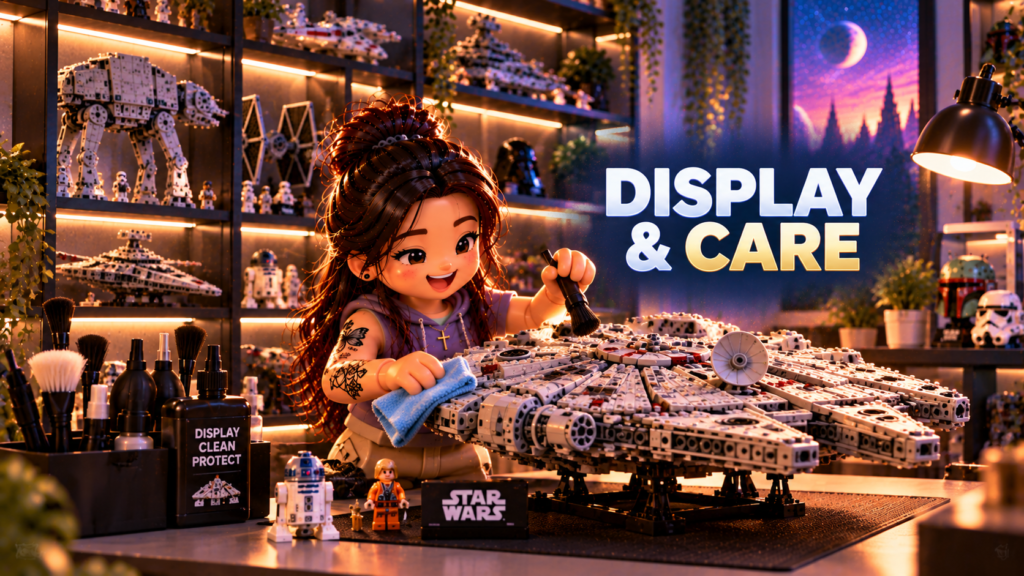
Finishing a huge LEGO Star Wars set creates a new problem almost immediately: where does it actually go? Large UCS and display-focused sets can be too deep for ordinary bookshelves, too long for a small console, or too fragile for a busy table.
The best display location is one that matches the finished model’s dimensions, gives it a little breathing room, keeps it stable, and fits the way you use the room. LEGO’s own guidance for massive sets makes the same basic point: measure first, think creatively about underused spaces, and treat the display as part of the project rather than an afterthought.
If you are still in the building stage, our large LEGO build preparation guide covers how to plan the workspace before Bag 1. This guide starts at the other end of the process, when the last piece is in place and you need a permanent or semi-permanent home for the model.
Where Is the Best Place to Display a Huge LEGO Star Wars Set?
Start with the places in your home that already have enough width, depth, and height. A deep console, sturdy cabinet, wide bookcase, dedicated LEGO shelf, hobby table, or unused section of built-in furniture may work better than a traditional narrow bookshelf.
LEGO recommends matching the space to the dimensions of the finished set and looking beyond standard display furniture when necessary. Its examples include converted cupboards, custom shelving, plinths, glass, and other creative display areas. That is useful advice because many large Star Wars models are shaped differently from ordinary decor.
Do not choose a location just because the model technically fits. Leave enough clearance that wings, engines, antennas, or other projecting sections are not constantly brushing against walls, doors, or people walking past.
Measure the Model Before You Measure the Furniture
The first number to check is the finished model size. Look at width, depth, and height separately. Piece count does not tell you how much room a set needs. A long capital ship, a wide-winged fighter, and a tall walker can all create completely different display problems even if their piece counts are similar.
Then measure the usable furniture surface, not just the advertised outside dimensions. Side walls, cabinet frames, doors, lips, support posts, and decorative trim can reduce the real space available to the model.
Our UCS Executor 75457 display-space guide is a good example. That model is more than 53.5 inches long, so a piece of furniture can look large in a room and still be too short or too shallow once the actual measurements are compared.
Will a Normal Bookshelf Work for a Large LEGO Set?
Sometimes, but depth is often the limiting factor. Many bookcases are designed for books, not wide spacecraft or large display models. A set may fit across the shelf but hang several inches over the front edge.
Overhang is not automatically a disaster, but it gives you less margin for accidental contact and can make the display feel crowded. If the model has a stand, check the footprint of the stand too. The stand may fit comfortably even when wings or other sections extend beyond the shelf.
Recent LEGO display discussions repeatedly focus on deeper shelving for large UCS sets. Builders often look for adjustable shelves, open-sided systems, or units with substantially more depth than standard bookcases. The common problem is not finding enough height. It is finding enough usable depth.
Should You Use an Open Shelf or a Display Cabinet?
An open shelf is usually simpler and gives you more flexibility with unusually shaped models. It is easy to access the set, change the angle, add minifigures, or rearrange the display. The tradeoff is exposure to dust and normal household activity.
A display cabinet adds protection and can reduce how often the model needs cleaning, but the interior dimensions matter much more than the outside dimensions. Door frames and glass panels can turn a cabinet that looks large enough into one that is too narrow or shallow.
The display location affects maintenance. Open shelves collect more dust than enclosed cabinets, while cramped displays are harder to clean because you cannot easily reach around the model.
What If the Set Is Too Big for Any Shelf You Own?
Do not assume you need to buy expensive display furniture immediately. First look for spaces that are already available but are not being used as traditional shelves. A wide sideboard, low cabinet, deep desk return, unused cupboard, sturdy bench, or dedicated section of a hobby table can become a display area.
LEGO’s own display guide encourages builders to think outside the usual display case. One featured builder converted a linen cupboard into a cabinet for large sets, while others use custom shelving, plinths, glass, and unconventional furniture.
You can also rotate displays rather than keeping every large build out permanently. If your collection outgrows the available room, displaying a few large models at a time can make each one more visible while avoiding a crowded wall of overlapping sets.
Can You Display a Large LEGO Star Wars Set at an Angle?
Yes, if the stand and display surface safely support that orientation. Angling a spacecraft can reduce its apparent width or depth and can make the model look more dynamic. LEGO’s display guidance specifically suggests experimenting with viewing angles for aircraft and spacecraft.
Do not improvise an unstable angle just to make a model fit. If you use an aftermarket or custom stand, make sure it is designed for the specific set and that the model is supported at appropriate structural points. A display solution should make the set safer, not more precarious.
Also think about sightlines. Many LEGO models are designed to be viewed slightly from above, where more surface detail is visible. A shelf close to eye level may work beautifully for one model while a lower console works better for another.
Should a Huge LEGO Set Go in a High-Traffic Room?
It can, but placement matters. A large set on a narrow table next to a doorway is much more vulnerable than the same set on a deep cabinet against a quiet wall. Think about people, pets, doors, chairs, vacuuming, and anything else that regularly moves through the space.
Keep fragile projections away from the edge whenever possible. A model that barely fits with a wing or engine hanging into a walkway may technically be displayed, but it is not a comfortable long-term setup.
If the room is shared, choose a location where the set can stay in place without becoming an obstacle. That usually matters more than whether the display looks perfect from every angle.
What About Dust, Cleaning, and Long-Term Care?
The display location affects maintenance. Open shelves collect more dust than enclosed cabinets, while cramped displays are harder to clean because you cannot easily reach around the model.
Leave enough room to access the set without lifting it every time the shelf needs attention. If the model is wedged tightly between walls or other sets, even basic cleaning becomes more difficult.
If you are using an open shelf or cabinet, our guide to keeping LEGO Star Wars sets from getting dusty covers display cases, placement, and prevention. If dust is already on the model, our guide to cleaning dust off LEGO sets without taking them apart explains how to clean assembled sets carefully.
Should You Plan the Display Before You Start the Build?
Whenever possible, yes. Large LEGO sets are much easier to plan around before they are assembled. Once a model is complete, moving it through doorways, around furniture, or up and down stairs may be more complicated than moving the sealed box. If you already know the set will need to travel, our guide to moving a large LEGO set safely covers partial disassembly, padding, lifting, and transport.
That is why our first LEGO Star Wars UCS set guide treats display space as part of the buying decision, not something to solve afterward. The finished model has to live somewhere long after the building session ends.
If the set is already built, do not rush the decision. A temporary safe surface is better than forcing a huge model onto furniture that is too small just because you want it displayed immediately.
A Simple Display Checklist for Huge LEGO Star Wars Sets
- Measure the finished model. Check width, depth, and height separately.
- Measure the usable display surface. Account for frames, doors, trim, and supports.
- Leave clearance around fragile sections. Do not let wings or engines sit directly in a walkway.
- Check stability. Use furniture and stands within their intended limits.
- Decide between open and enclosed display. Balance accessibility with dust protection.
- Consider the viewing angle. Some models look better and fit better when angled.
- Think about maintenance. Leave enough room to reach the model for cleaning.
- Rotate large displays if space is limited. Every completed set does not have to stay out forever.
The main idea is simple: the display should fit the model, the room, and your actual life. A huge LEGO set is easier to enjoy when you are not worried about bumping it every time you walk past.
Next Steps: Give the Finished Build a Real Home
When a large LEGO Star Wars build is finished, do not treat display space as whatever empty surface happens to be nearby. Measure the model, find a stable location with enough depth and clearance, and decide whether an open shelf, cabinet, console, or more creative space makes the most sense.
If you are working through the Tiny Force large-build path, the next step after organizing the pieces during the build is making sure the completed model has somewhere safe to live. Explore The Holocron for more LEGO Star Wars building and display guides.