
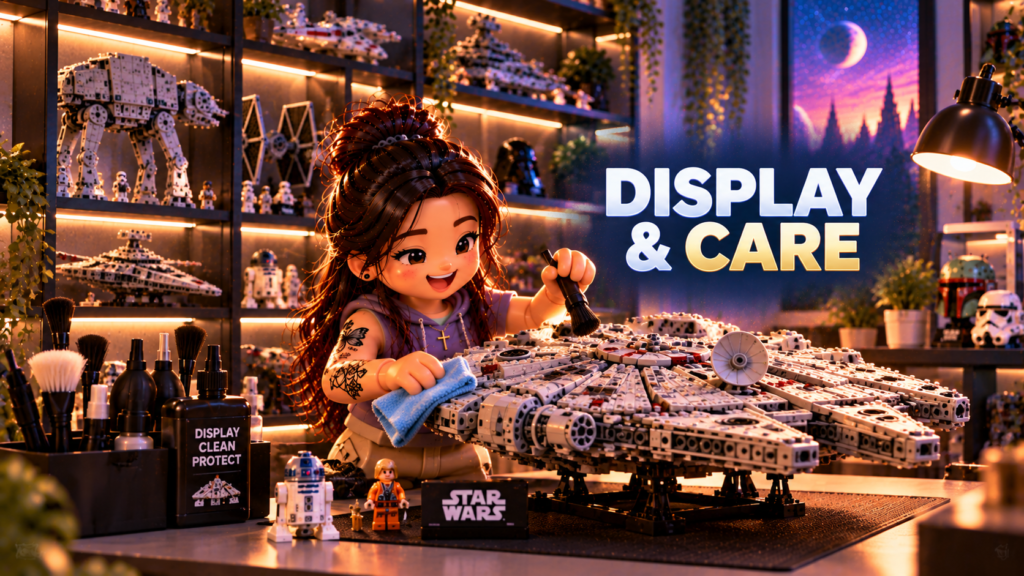
Dust is one of the least exciting parts of displaying LEGO Star Wars sets, especially once the collection starts growing. Open shelves, large UCS models, helmets, droids, and display ships can all collect a visible layer surprisingly quickly.
You cannot stop household dust completely, but you can slow it down. The most effective approach is to reduce how much dust reaches the set in the first place, keep the surrounding area clean, and lightly remove new dust before it builds into a stubborn layer. LEGO itself recommends dusting displayed creations with a soft brush from time to time.
If you are still deciding where a large model should live, start with our guide to displaying a huge LEGO Star Wars set. The display location you choose can make future dust control much easier.
What Is the Best Way to Keep LEGO Sets From Getting Dusty?
The strongest dust-prevention strategy is simple: reduce exposure. An enclosed cabinet or display case limits the amount of airborne dust that can settle directly onto the model. It will not necessarily make the set permanently dust-free, but it can greatly reduce how often you need to clean it.
If a case is not practical, focus on placement and routine. Keep the display surface itself clean, avoid placing the model where people constantly brush past it, and give the set enough room that you can reach around it with a soft brush. A crowded shelf is harder to maintain than one with a little breathing room.
For most open displays, the goal is not zero dust. The goal is preventing dust from building up long enough that cleaning becomes difficult.
Are Display Cases Worth It for LEGO Star Wars Sets?
If dust is your main concern, a display case is the most direct physical barrier between the model and the room. Community discussions around large LEGO Star Wars collections repeatedly point to enclosed glass or acrylic displays as the easiest way to reduce dust on expensive or difficult-to-clean models.
The downside is cost and size. A compact helmet may fit into an inexpensive case, while a large UCS ship can require oversized furniture or a custom cover. The case also needs enough interior clearance that wings, antennas, or display stands are not touching the sides.
Before buying any enclosure, measure the actual model and the usable interior dimensions of the case. Do not rely only on the outside dimensions listed for the furniture.
Where Should You Put LEGO Sets to Reduce Dust?
A quieter display area is generally easier to keep clean than a surface that sits in the middle of constant household activity. Think about doors, vents, fans, pets, frequently used furniture, and areas where people walk past the display all day.
The idea is not that one side of a room is magically dust-free. It is simply easier to maintain a set when the surrounding area is stable, reachable, and not constantly disturbed. A model on a deep cabinet against a wall is usually easier to care for than the same model balanced near the edge of a busy table.
Make sure the placement also gives you enough room to clean around the set. If the model barely squeezes between other displays, even a quick dusting becomes awkward.
How Often Should You Dust a LEGO Display?
There is no universal schedule because homes differ. A set in an enclosed cabinet may need attention far less often than one on an open shelf. Instead of following a rigid calendar, look for the first visible film of dust and remove it while the layer is still light.
LEGO recommends using a soft brush on displayed creations from time to time. That is a useful prevention habit because light dust is easier to remove than buildup that has settled deep between studs, tiles, grilles, and small decorative elements.
A quick visual check when you dust the furniture around the set is usually enough to tell you whether the LEGO model needs attention too.
What Should You Use for Light Dusting?
For light surface dust, use a clean, soft brush that can move between studs and around small details without pulling parts loose. LEGO specifically recommends a soft brush for displayed creations. Community builders commonly use soft makeup brushes or shaving brushes because the bristles can reach narrow spaces while remaining gentle.
Work slowly around antennas, small tiles, minifigure accessories, and greebling. Large display models can contain hundreds of small exposed details, so aggressive dusting can create more work if pieces are knocked loose.
This article is focused on prevention and light maintenance. If dust has already built up, our guide to cleaning dust off LEGO sets without taking them apart covers soft brushes, tight spaces, optional vacuum use, and when moisture may be appropriate.
Does Cleaning the Room Help Keep LEGO Sets Cleaner?
Yes, because the set is part of the room. Dust that settles on the shelf, cabinet, nearby furniture, and floor can eventually reach the model too. Keeping the display furniture and surrounding area clean reduces the amount of loose dust sitting immediately around the LEGO collection.
This is especially useful for large open displays. Instead of waiting until the model looks dirty, treat the shelf and the set as one display area. Wipe the furniture around the model and lightly brush the set before the dust layer becomes obvious.
If you own several large sets, this routine can be easier than trying to deep-clean every model after months of buildup.
Should You Cover a LEGO Set When You Are Not Displaying It?
If a model is temporarily sitting on a table while you decide where to display it, a loose protective cover can reduce dust exposure. The important part is avoiding anything that presses against antennas, wings, small decorative pieces, or other fragile sections.
A rigid clear cover is better for long-term display because it protects the model without touching it. For short-term protection, make sure any temporary cover is clean, lightweight, and placed so it does not snag on the build.
If the set is going into storage rather than remaining assembled on display, that becomes a different problem. Storage, disassembly, and packing are better handled separately from everyday dust prevention.
Do Large UCS Sets Need More Dust Protection?
They do not require a different kind of plastic care, but their size can make dust control more difficult. A large ship has more exposed surface area, more detailed sections, and often more places where dust can settle. Reaching the center of a wide or deep model may also be harder once it is on the shelf.
This is another reason display planning matters. Our first LEGO Star Wars UCS set guide recommends thinking about the finished display before buying or building the set. Dust access belongs in that decision too.
If you cannot comfortably reach the top, sides, and surrounding shelf, routine care will probably become more difficult over time.
What Should You Avoid When Trying to Keep LEGO Sets Clean?
Do not turn routine dust control into an unnecessarily aggressive cleaning project. LEGO’s official cleaning guidance says loose bricks should be hand-cleaned with water no hotter than 104°F (40°C), using a soft cloth or sponge, with mild detergent if needed. LEGO also warns against washing machines, dishwashers, ovens, microwaves, hair dryers, and direct sunlight for drying.
That guidance is mainly for cleaning individual pieces, not for soaking an assembled display model. Large finished sets may contain stickers, mechanical assemblies, metal-containing parts, electronics, or spaces where water could remain trapped.
For normal display dust, start with the least invasive method: prevention, a soft brush, and regular light maintenance.
A Simple Dust-Prevention Routine for LEGO Star Wars Sets
- Choose a stable display location. Avoid surfaces that are constantly disturbed.
- Use an enclosed case when practical. It provides the strongest physical barrier against settling dust.
- Keep the shelf or cabinet clean. Treat the model and its display surface as one area.
- Check the set regularly. Remove light dust before a heavy layer develops.
- Use a soft, clean brush. Work carefully around small details and fragile sections.
- Leave room around the model. Easy access makes routine maintenance much simpler.
- Plan before buying giant sets. Make sure the final display can actually be reached for cleaning.
The system does not need to be complicated. Prevent as much dust as you reasonably can, then deal with the small amount that remains before it becomes a bigger cleaning job.
Next Steps: Keep the Display Easy to Maintain
The best way to keep LEGO Star Wars sets from getting dusty is to combine smart display placement with simple maintenance. Enclosed cases help the most, but open displays can stay manageable when the surrounding area is clean and light dust is removed regularly with a soft brush.
If your collection is still growing, pair this guide with our large LEGO Star Wars display guide. Explore The Holocron for more Tiny Force build, display, and care guides as the collection expands.